Long before rosehip became a face oil, it was food, medicine and winter provision. Then natural beauty discovered in its rust-colored oil something it had been looking for all along: a plant ingredient that could feel ancient and modern at once. More than three decades into its modern skincare life, rosehip has somehow escaped both novelty and obsolescence.
The rose is usually remembered at its most theatrical.
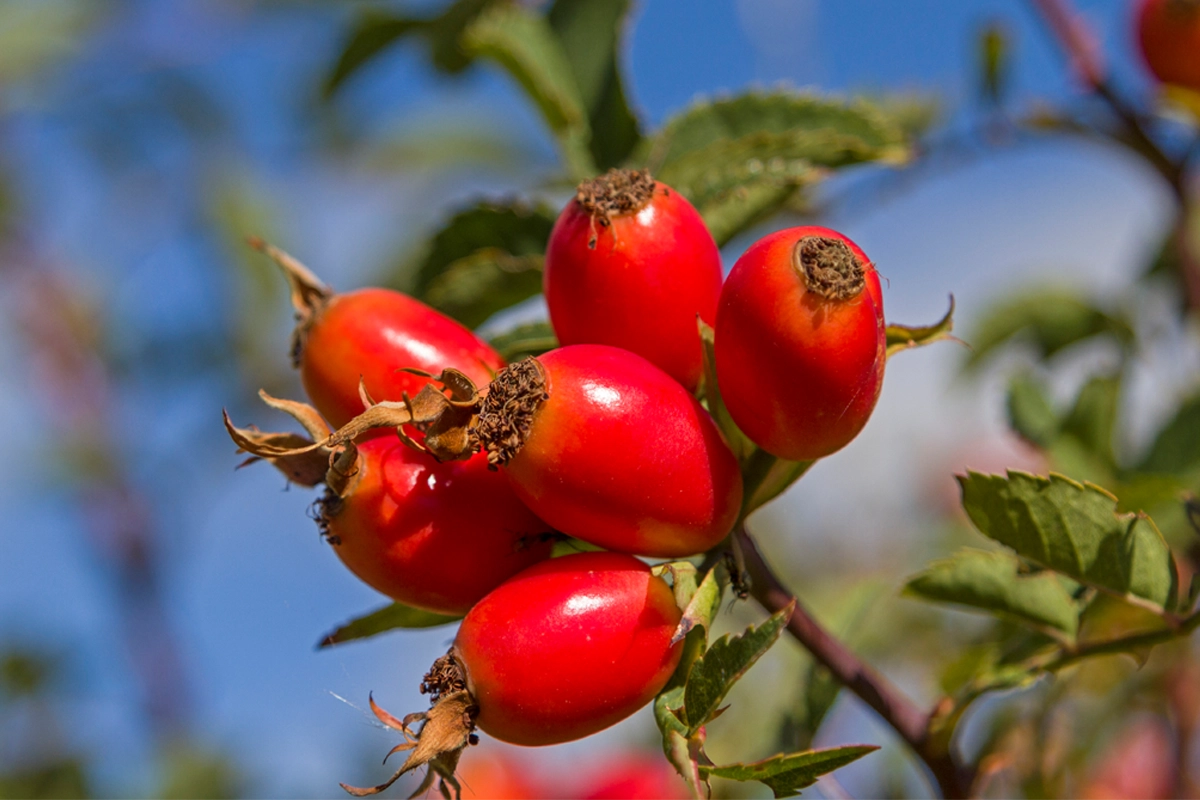
There are the petals, of course. The perfume. The extravagant symbolism that has followed the flower through poetry, painting, gardens and bottles of fragrance for centuries. Rosehip enters the story after all of that has finished. When the petals have fallen, what remains at the base of certain wild roses swells into a small, firm fruit, usually vermilion or burnt orange, containing the seeds from which the oil prized by modern skincare is extracted.
It is, in other words, the part of the rose that comes after the rose.
And for most of its history, the hip was considerably more practical than romantic.
Wild roses belonging to species such as Rosa canina grew across Europe, western Asia and North Africa, where their fruits became food and medicine long before anyone thought to place an amber dropper bottle on a bathroom shelf. Pliny the Elder recorded a preparation involving dog rose in the first century; centuries later, Avicenna included Rosa canina in his medical writings. Across parts of Anatolia, rosehip preparations entered traditional remedies for wounds and skin ailments, while Ottoman-era records also describe medicinal use. In twentieth-century Britain, rosehips assumed an altogether less glamorous role when the government encouraged their collection as a domestic source of vitamin C during the Second World War.
There is something important in this chronology. Rosehip was not originally a “beauty ingredient.” It belonged to the much older category of useful plants.
Its contemporary skincare story would be written much later and, somewhat unexpectedly, thousands of miles away.
A European rose in Chile
The geography of rosehip beauty is more complicated than the mythology that eventually surrounded it.
Chile became so closely associated with rosa mosqueta that rosehip oil is sometimes narrated as though the plant itself originated there. It did not. The wild roses that became commercially significant in Chile—including Rosa rubiginosa, the species particularly associated with Chilean rosehip oil—came from the Northern Hemisphere. Chilean government biodiversity records classify Rosa rubiginosa as an introduced species, while botanical histories describe European roses arriving with settlers and spreading spectacularly through the country’s temperate landscapes.
The plant proved almost embarrassingly well suited to its adopted home.
Across south-central Chile, rose bushes naturalized over enormous areas. What agriculturalists could regard as a vigorous weed eventually became a raw material. By the 1970s, Chile was actively developing an export market around rosehip for foods, teas, natural medicines and cosmetics; today the country remains one of the ingredient’s major international sources.
This is where rosehip begins to acquire the identity beauty recognizes today: not the tart red fruit made into syrup, but its vividly colored oil.
Stories about Chilean research into rosa mosqueta’s effects on damaged skin circulated through the natural-health world during the 1980s and early 1990s. The evidence base was never quite as neat as later beauty folklore made it sound—rosehip’s reputation for scars, in particular, has often run ahead of the small number of good human studies—but the idea was powerful enough to travel. A 2024 review of rosehip and wound healing found some promising evidence while emphasizing how limited the clinical literature remains.
In beauty, however, ingredients do not become important through clinical evidence alone. They also require a story that arrives at the right cultural moment.
Rosehip was about to find one.
Before “clean beauty” had a name
In 1993, Australian entrepreneur Marie Kapetanakis founded Kosmea after encountering rosehip oil and becoming fascinated by its potential. The company describes itself as the first to bring bottled rosehip oil to the Australian market; Kapetanakis initially sold it through health-food shops and pharmacies.
That route to market now feels almost like a map of pre-internet natural beauty.
Before Instagram shelves, ingredient search engines and the polished vocabulary of “clean,” there were health-food stores. Organic shops. Aromatherapy aisles. Independent apothecaries. Products were often discovered through recommendation rather than campaign. Their relative lack of cosmetic sophistication was part of the appeal. An oil could be valuable precisely because it looked as if very little had happened to it.
Rosehip suited this world beautifully.
It smelled faintly vegetal. Its color could range from gold to deep orange. It oxidized more readily than heavier, more stable oils because its lipid profile is unusually rich in polyunsaturated fatty acids. It therefore rewarded freshness, careful extraction and dark packaging. Each of these characteristics could be read as evidence of authenticity rather than imperfection.
Chemically, there was enough substance beneath the romance. Rosehip seed oil is notably rich in linoleic and alpha-linolenic acids, alongside tocopherols and phytosterols; the fruit contains an unusually varied carotenoid profile, including beta-carotene, lycopene, lutein and related compounds.
It gave natural beauty something it badly needed at the time: an ingredient that felt simple without feeling unsophisticated.
Then came Trilogy.
Founded in New Zealand in 2002, the brand placed Certified Organic Rosehip Oil among its original five products and made the ingredient foundational to its identity. Two decades later, Trilogy still describes that oil as its founding hero.
If Kosmea helped establish a market for rosehip as a bottled treatment, Trilogy helped turn it into an international natural-beauty category.
But it was another brand, almost a decade later, that would subtly change what consumers believed a rosehip oil could be.
The Pai effect
Pai began in London in 2007 with a very specific constituency in mind: people with sensitive and reactive skin who wanted organic skincare without the rather vague formulations then frequently hiding behind the words “natural” and “hypoallergenic.”
In 2011, it introduced Rosehip BioRegenerate Oil.
The formulation was important because Pai did not approach rosehip simply as a carrier oil to be sourced well and cold pressed. The company used supercritical CO₂ extraction and incorporated material from both the fruit and seed, producing the saturated orange-red oil that would become one of the brand’s signatures. Pai says the product has since sold millions of bottles.
This represented a subtle but consequential shift.
Rosehip was no longer merely a pure natural oil.
It was becoming an active.
Extraction method entered the conversation. Fruit versus seed entered the conversation. Antioxidant concentration entered the conversation. Color ceased to be incidental and became almost evidentiary: a darker orange oil looked richer, fresher, more biologically alive.
It is difficult to separate rosehip’s rise during this period from the larger transformation happening to face oils themselves.
For years, oil had occupied an awkward place in Western facial skincare. Consumers who had been taught that shine meant grease and grease meant blemishes were understandably suspicious of putting more oil onto their faces. The green-beauty movement reversed much of that logic. Jojoba, argan, marula, sea buckthorn and rosehip were presented not as generic oiliness but as distinct botanical lipid profiles with individual compositions, origins and purposes.
Suddenly, the oil mattered.
So did where it came from, how it had been pressed and whether it had been refined.
Rosehip was particularly well adapted to this new ingredient literacy. It had a botanical name. A recognizable geography. An unmistakable color. A story about traditional use. A composition involving both essential fatty acids and antioxidants. And, crucially, it acquired one phrase that condensed all of that complexity into something consumers immediately understood:
natural retinol.
The usefulness of an imperfect phrase
Scientifically, “natural retinol” is an untidy description of rosehip.
Rosehip oil is not retinol.
It is rich in compounds connected with vitamin-A biology, most notably provitamin-A carotenoids such as beta-carotene. Claims that ordinary rosehip seed oil naturally contains meaningful amounts of trans-retinoic acid have also proved difficult to pin down consistently: one analytical investigation of commercially acquired Rosa rubiginosa oil found no detectable tretinoin at all.
This does not make rosehip uninteresting. If anything, the reality is more interesting than the slogan.
Its skin value arises from a broader biochemical architecture: polyunsaturated fatty acids, tocopherols, phytosterols, phenolic compounds and carotenoids, varying by species, geography, extraction and whether the fruit or seed is being used. Contemporary studies continue to investigate its effects on skin, but rosehip should not be understood as botanical tretinoin in a bottle.
Culturally, however, “natural retinol” was almost perfect.
Retinoids represented everything natural beauty once struggled to communicate: visible change, seriousness, dermatological legitimacy. Yet they also carried associations with peeling, dryness, irritation, prescription medicine and, for some consumers, an aesthetic of aggressive intervention.
Rosehip occupied the psychological space beside them.
It promised renewal without looking clinical. It could be associated with age, texture, marks and uneven tone while remaining an oil pressed from a plant. It allowed natural-beauty brands to speak the language of correction without abandoning the language of nourishment.
The distinction mattered particularly during the 2010s, when green beauty was shedding its crunchy reputation and becoming increasingly luxurious. The new natural skincare did not want to be chosen merely because it excluded something. It wanted to compete on performance.
Rosehip became evidence that perhaps it could.
The oil inside the oil
By the latter half of the 2010s, rosehip had reached an unusual stage in the life cycle of a beauty ingredient: it was simultaneously hero and supporting actor.
There were still bottles containing little else. But it had also become part of the underlying grammar of prestige face oils.
Herbivore built its Phoenix oil around rosehip and sea buckthorn. KORA Organics put rosehip alongside noni, jojoba, sea buckthorn and pomegranate in its Noni Glow Face Oil. Votary eventually made the relationship between rosehip and vitamin A unusually literal, pairing rosehip with an actual retinoid in its Intense Night Oil.
And these were only especially visible examples.
By then, reading the ingredient lists of natural and premium face oils could feel a little like spotting the same familiar members of an ensemble cast. Jojoba for affinity. Sea buckthorn for color and carotenoids. Argan for richness. Squalane for elegance. Rosehip for renewal.
Its presence often no longer required explanation.
That may be the surest sign that an ingredient has actually entered the canon.
Then everyone could buy it
Prestige is only one part of rosehip’s history.
The same ingredient that had once required explanation at a health-food counter eventually became so comprehensible to consumers that it could be sold with essentially no story at all.
The Ordinary’s 100% Organic Cold-Pressed Rose Hip Seed Oil is perhaps the clearest expression of that transition. Its current formula consists simply of Rosa canina seed oil, sold in the brand’s familiar clinical dropper format at a price radically below the prestige face-oil category.
By this stage, rosehip had completed a remarkable migration.
The ingredient moved from traditional medicine to natural-health curiosity; from curiosity to organic-beauty hero; from hero to luxury formulation component; and finally from luxury to commodity.
But democratization did not kill its prestige.
That is another unusual thing about rosehip.
Normally, beauty ingredients move rapidly through a cycle of discovery, saturation and fatigue. Once an ingredient appears everywhere—from a $150 serum to a drugstore mask—the prestige market starts searching for something consumers have not yet heard of.
Rosehip largely escaped that fate.
Perhaps because there was never one singular rosehip product to commodify.
Species differ. Seed oil and fruit extracts differ. Cold pressing and CO₂ extraction produce different compositions. Growing region matters. Harvest matters. Refining matters. Freshness matters. Carotenoid content matters. The phrase “rosehip oil” can therefore describe both a simple commodity ingredient and an unusually considered botanical material.
Beauty could make it cheaper without exhausting it.
What comes after ubiquity?
Which brings rosehip to an interesting place in 2026.
Its newest expressions are not really attempts at rediscovery. Everyone already knows rosehip.
Instead, brands are beginning to ask whether a familiar botanical can be made more complete.
Gentler Essentials recently introduced Rosehip Reverence, and its construction is revealing of this new stage. Rather than relying on a conventional single rosehip seed oil, the formula layers fresh-pressed organic Rosa canina seed oil with supercritical extracts of both fruit and seed and a separate rosehip carotenoid concentrate. The company describes the result as its attempt at the most complete expression of the plant.
Viewed simply as a launch, it is another rosehip oil.
Viewed historically, it represents something more specific.
Kosmea’s proposition in the 1990s was essentially discovery: here is rosehip oil.
Trilogy’s was purity and quality: here is certified organic rosehip oil made into a cornerstone of modern natural skincare.
Pai’s intervention was extraction and concentration: rosehip does not have to mean mechanically pressed seed oil alone.
The Ordinary’s was access: this ingredient no longer needs to be rare or expensive.
Gentler Essentials arrives after all of those arguments have already been made. Its proposition is therefore one of completeness—seed oil, fruit, seed extract and isolated carotenoid-rich fractions considered as different expressions of one plant rather than interchangeable versions of the same material.
There is something circular about it.
Beauty spent years dismantling plants into ever more specific molecules. Now, at the higher end of botanical skincare, one increasingly sees the opposite instinct: use technology not to escape the whole plant but to reconstruct more of it.
Rosehip is particularly suited to this thinking because the part most consumers know—the seed oil—is only one fraction of the fruit.
The innovation is no longer finding the rosehip.
It is asking how much of the rosehip has been left behind.
The ingredient that stayed
Beauty has changed dramatically since a bottle of rosehip oil first looked exotic on the shelf of an Australian health-food store.
The industry moved through organic beauty, green beauty, clean beauty, clinical skincare, ingredient minimalism, biotech and the current fascination with longevity. Consumers learned words like microbiome, peptide, ceramide, ectoin and exosome. Whole categories of botanicals rose and disappeared in the interval.
Rosehip stayed.
Not unchanged, exactly.
Its meaning kept adapting.
To one generation it was a healing oil. To another, the emblem of organic skincare. To another, “natural retinol.” Later it became a familiar component of sophisticated oil blends, then an inexpensive single-ingredient staple. Today it can once again become the object of technical scrutiny: Which species? Which part of the fruit? Which extraction? How concentrated? How fresh?
This ability to inhabit several worlds at once may be the real explanation for its longevity.
Rosehip can be old-world herbalism and ingredient science. It can be a one-ingredient formula and a complex extraction story. It can sit in a ten-dollar bottle or form the architecture of a prestige treatment. It is gentle enough to belong to the vocabulary of sensitive skin and active enough, at least culturally, to have spent years in conversation with retinoids.
Most importantly, it has never depended entirely on novelty.
The flower disappears every year.
The hip remains.
And perhaps that has always been the point.